
This post explores the results of our ongoing ‘Hyperlocal’ collaboration with the University of Brighton (you can see the 2025 project description here), and particularly the testing carried out in September 2026.
In June, we published a newsletter that said:
‘Widespread adoption of AI via Large Language Models is controversial – the content is not always reliable, and the environmental impact of the data centres is often terrible. If we’re going to use AI – and it’s not a given – we need to ensure that we do so with sound reasoning, and an ethical approach.
Last year we ran a small pilot where an “app” created “stories” using content from our archive, which the user could listen to as they walked local streets. We have taken on the feedback from that pilot – for example, the app is now easier to use, and we’ve ensured that it has a low environmental impact (less than 2% of commercial models).’
Subsequently, we published information about our Heritage Open Days testing events, which further explained our rationale:
‘QueenSpark’s archive is an extraordinary collection of first-person histories, telling the story of Brighton by the people that live(d) here.
The increasing use of AI and Large Language Models means that community archives such as QueenSpark’s are at risk of our content being “scraped”, loss of attribution, and misrepresentation of source materials. We also know that many – particularly younger – people use their phones rather than PCs to access the internet nowadays, and that much of their usage is via audio and/or video, not text.
These two factors mean that it is important that local archives, amid an era of huge technological change, explore ways that we a) negotiate the use of AI ethically, and b) broaden our audience to include those who might not read historical archives in “traditional” format.’
(Alongside the two days of testing during Heritage Open Days, we also carried out similar testing over two days with students at the University of Brighton.)
When we sent the newsletters, most e-mail responses we received fell broadly within the range of: ‘I have worries about AI, but I can also see how it might be used for good’. But it’s fair to say there were quite a few expressing deep concern. These ranged from worries that we might ultimately deprive real people of creative opportunities and/or income, to questions about who owns and controls AI, its environmental impact, and the integrity of the archive and its contributors.
The chief criticism we received was of the idea that we were going to be ‘fictionalising’ our archive and creating ‘stories’ based on the first-person testimonies entrusted to us. Essentially, people questioned whether these testimonies were ours to ‘fictionalise’, and whether we could – or should – be employing actual writers to create stories.
‘Fictionalised’ and ‘stories’ were our phrases, which we’d used when publicising the events.
That was a mistake on our part.
Were they really ‘stories’?
We had publicised the event a few months in advance but, because this was a time-limited research study, we only got to test the app around ten days before the events took place. At that point, it became clear that the app – due to the parameters set by the researcher – was not going to create ‘stories’ in the way we had initially imagined. The outputs were, in fact, closer to short descriptive vignettes drawn from our books.
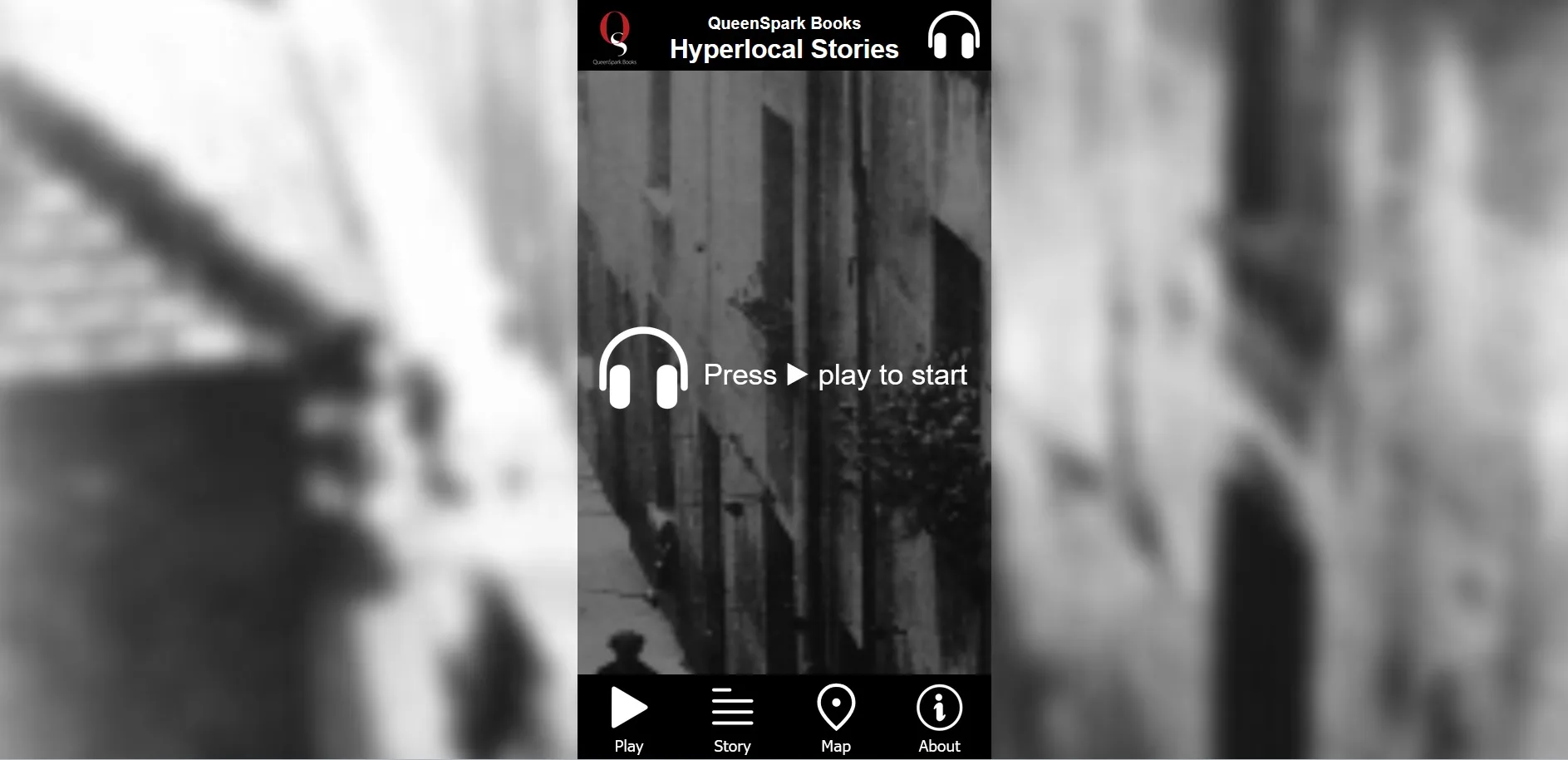
The app drew on material from books relating to the place where the user was standing, condensed that material into a paragraph or two, and presented it in the third person. These were not fictional narratives in the conventional sense, but short descriptive pieces based on existing archive sources. Here is a randomly generated example, collated from our books Backyard-Backstreet Brighton and Boxing Day Baby:
‘Life in this area was marked by hard work and resilience. Women like the owner of Hughes’ shop, a saddle and shoe maker, had to balance family life with working long hours in the family business. She, along with her sister Min, would dance on the counter of their family’s beer house, ‘The Little Wonder’, to entertain customers. Many men, including her uncle, relied on drink to escape the hardships of poverty and deprivation. The younger generations, like the one who recalled their mother’s daily routine, also knew the value of hard work. They remember their mother standing at the tubs, washing clothes by hand, using soda and a bar of Sunlight soap, with a big mangle to wring out the water. The children helped by turning the handle, a task that was just one of many that filled their days.’
So, how we described our use of AI shaped how people understood and responded to it, leading to justified concerns. To be clear, this project will not ‘replace’ writers: first, we have no identified funding route for a project in which writers creatively interpret our archive – and in any case writers can already do this, because the archive is freely available. Second, we are not a ‘creative writing’ organisation; our long-standing friends at New Writing South have that base covered in the city.
Nevertheless, we should acknowledge that selecting, combining and rephrasing historical material is itself an act of interpretation, whether it is done by an author or a computer, and we need to be honest about that.
It is also important to note that nothing we do in this field will affect or replace the current archive. Our research is an attempt to find new ways to point people towards it which, if successful, could help us attract new audiences and secure future funding to preserve and sustain the original.
What did people think?
Our University research partner is still processing the data from the questionnaires that participants completed during the testing events, which focused on the stories – in particular, whether people found them interesting and reflective of the lives of the people who lived here; the voices used to narrate them; and how the experience affected their attitudes towards the local area and their interest in local history and our archive.
Here, we want to reflect instead on the more informal responses we received in conversations before and after people tested the app. These observations are not a substitute for the formal research, but they offer a useful insight into the range of reactions the experiment prompted.
You might not be surprised to learn that reactions varied. Some people thought it was great – in concept, if not necessarily in its content, given that this was an experimental version drawing on books we had pre-selected. Some thought it was OK; some hated it. Here’s a sample of those responses:
‘It didn’t feel ‘authentic’ – neither the way the text was presented, nor the text itself’.
‘This is the sort of thing that someone like me – a student, from another country, and new to the city – needs to help us understand the history of where we are. I’m going to share it with all my friends’.
‘You should be focusing on publishing more books – this was really alienating’.
‘I would never normally come across your books; if this app was promoted properly, I and others would be more likely to find out about the area I live’.
(One interesting pattern did emerge from these conversations, although it is anecdotal rather than formal research: younger participants, particularly students, tended to be more enthusiastic about the app than older participants. The students also had no prior knowledge of QueenSpark, whereas many of the older participants already knew something about us. We can’t draw firm conclusions from such a small sample, but the contrast raises an interesting question: might people encountering QueenSpark for the first time see possibilities in this technology that those already familiar with our work view differently?)
The majority of testers were happy for us to continue exploring and researching the use of AI – although, of course, that might reflect self-selection: someone who didn’t want us to continue wouldn’t necessarily have turned up to the event!
It’s worth remembering that what people experienced was an early prototype, based on a small selection of books we had pre-selected. The app currently provides visual, audio and text descriptions of the books from which the content was drawn, but no live links. If a future iteration is funded, we would want those descriptions to link directly to the relevant material in our online archive or – where books remain in print – to the books themselves. Our aim would be to make the journey from an initial encounter with local history to discovering the original source as easy as possible.
So, should QueenSpark use AI?
The voices and stories contained in our archive are unique, interesting and powerful, and QueenSpark’s responsibility is to ensure that as many people as possible can access them. This includes finding ways of attracting new audiences, particularly people who might never otherwise come across our books.
For now, we are interested in continuing this exploration, and are seeking further research funding to develop it. We do want to use emerging technology to widen access to our archive – but we are aware that we need to be clear about what has been selected, how it has been reworked, and always ensure that, with regard to the integrity of the archive and of QueenSpark itself, nothing is lost in the process.